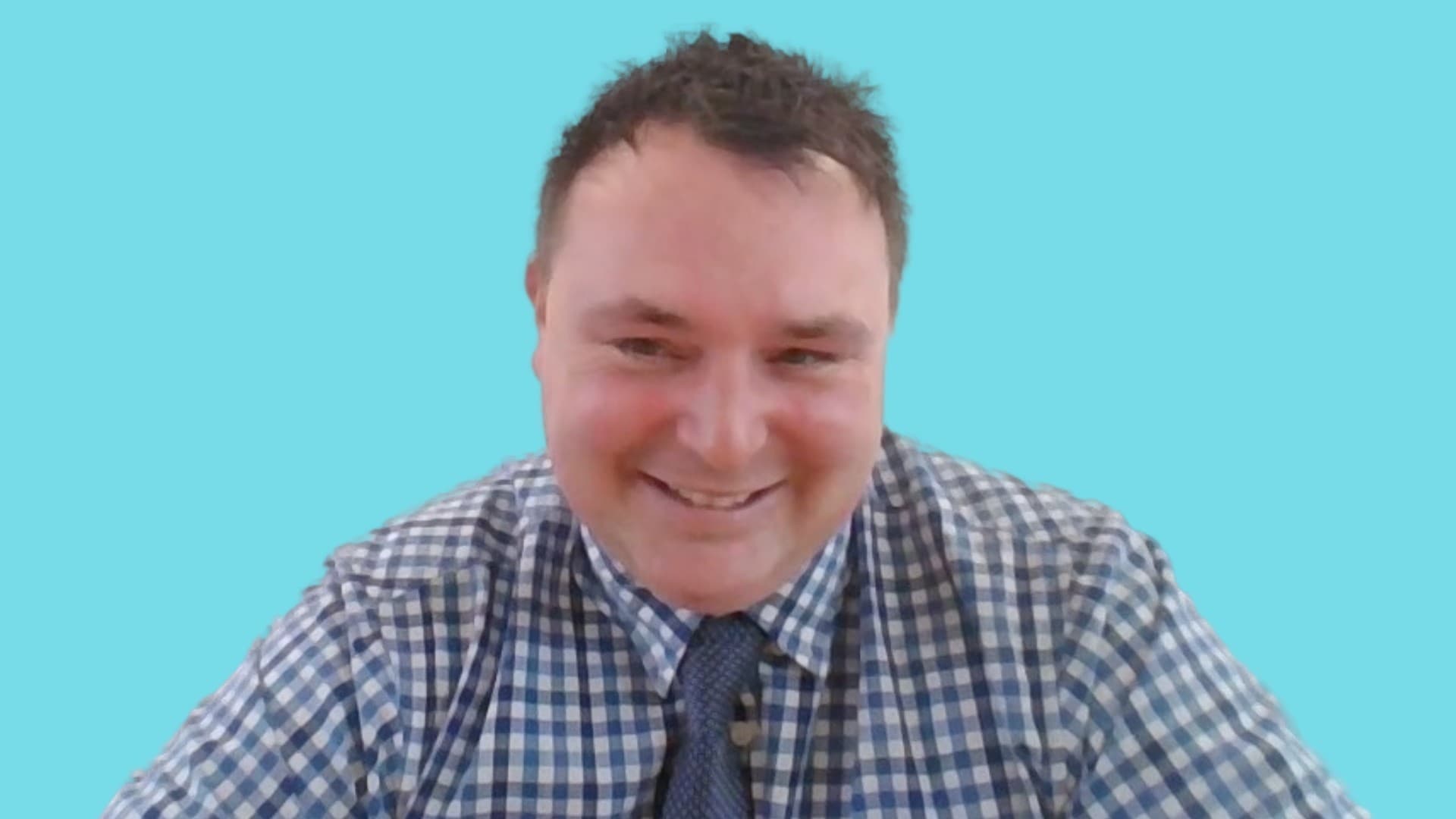
Thomas Howlett
Meet Thomas, a geophysicist who loves working outdoors, travelling the country, and mapping what lies beneath our feet.
So my name's Thomas Howlett. I am currently based out of Surrey but work all over and I currently work for an engineering firm called AECOM as a lead geophysicist.
So much of my job revolves around doing site work, specifically for civil engineering projects.
So before an energy pylon or any sort of building goes in, the engineers need to know what's underground in terms of the geology, any risks that are there, so that the engineers can adequately plan their foundations of where they want to put the building.
So my job, currently, is to lead a team of other geophysicists, and we go around the country collecting geological data, essentially, it's geophysical data about the underground, and which we then process into an image about the geology, and we give that to an engineer who does the engineering stuff.
So we start off the day nice and early. We have a briefing about what we're planning to do for the day. So we'll tell everyone what we're planning on doing, any risks, if there's like livestock in the field, which we have to be aware of.
And then there's paperwork you have to sign. That's basically saying everyone's listened, they're gonna be fine.
The rest of the day is then taken up with setting out our geophysical equipment and collecting the data. So that can take eight, ten hours, depending on the weather. In the summer, you can obviously survey a bit longer because it's lighter.
And then towards the end of the day, we pack up all the kit and we go back.
As a lead geophysicist, my day then carries on into the evening. I've got paperwork I have to complete and send it to the client saying, this is what we've done, are you happy with it?
And there's sort of preliminary processing I have to do. So I have to look through the data we've collected for that day and see that actually it is fit for purpose.
Because there's no point going back home after the site and what we've collected is corrupted or is it's not good enough. So I have to try and catch those mistakes before we're all done.
So I work with other geophysicists from AECOM. Periodically we will have representatives from the client coming onto site and ensuring that we're doing what we're meant to be doing. Occasionally we interact with members of the public and that's a way to be a bit more diplomatic and put on your smiley face. But yes, the immediate colleagues are other geophysicists from AECOM.
We do rotations, sort of mix and change, usually you're with the same sort of people because you'll rotate in the same periods of time. But as to how we work together, you really develop a sort of camaraderie because you're around each other all the time.
Often we're in sort of an Airbnb or something. So you're sort of right on top of each other cooking and cleaning and all sorts. So yeah, you really you do get along. You sort of know a lot about each other.
But that's really important because when you're on site it can be difficult if it's lashing it down with rain, you're up in the mountains, you're cold, you're tired. It's mentally and physically exhausting at times. So you really do have to kind of keep an eye on each other.
I just love getting outside. I hate being chained to a desk. I've done desk work before where you're sort of doing a forty-hour week, nine to five, and it gets tiring. You're kind of cooped up indoors all day and yeah, you wanna be outside.
I just enjoy being outside even if it's raining. I've been working in the Scottish Highlands before where in October you've got fifteen minutes of sun and fifteen minutes of cloud and the wind and the rain comes, and it's back round to sun and some people don't like that.
It's why I chose to go into geology. It's because I enjoy being outside. And yeah, it's travelling around the country, around the world.
So funny enough when I was in school I didn't really know geology was a thing.
I'd loved volcanoes, tsunamis, all the physical geography type stuff. And I guess I was in year eleven, year twelve of school and that question was kind of like what are you gonna do after school? What A-levels are you gonna choose and go down? And I knew which A-levels I wanted to do 'cause I had interest in the sciences and things.
But after that I had no real idea and one of my mum's friends worked for the national oil company for Austria, they're called OMV. And she said, why don't you try geology? That's all the sort of things that it sounds like you enjoy. So I looked into it. I went to interview and really really loved it and I spent three years at Royal Holloway in Surrey over in Egham.
And yeah, I loved every minute of it. You're being sent around the world looking at cliffs and sort of understanding the processes that make the earth how they are today.
But even as I was doing my degree, I was still forming an idea of what kind of career I wanted to do. People are chucking ideas at you.
And also the big one is oil and gas, because at the time it's where you went to make money. So I thought, well I'll go off and do that and did my master's in petroleum geoscience, which is tailored towards exploration, oil and gas. But its skill sets aren't unique to oil and gas. It's the understanding of geology and the history of what made that area how it is.
I started working for a small geophysical consultancy out in Oxfordshire. And they sent me off on all these projects for predominantly wind farm installation offshore. So I'd be doing the surveys for cable installation and making sure they're burying the cable deep enough, looking at the geology. And that's what really sort of started my interest in geophysics.
And then I worked for a big company called Fugro, they're international, they do all the site investigation. And I worked for them for a couple of years, two and a half years, and that's where I really found my passion for geophysics and sort of figured out what within geophysics I enjoyed doing because there's so many different techniques. I kind of found what I enjoyed doing.
I think it's giving you that passion for the sciences.
I think it depends on the school and the teachers, but definitely teachers I had, they were really passionate about the subject and they gave you that passion to learn more, to question why and not just to sit there and be like, it's just to accept the fact.
So I think that's yeah, really where I really got the zeal for it and I think even in university I didn't quite know how to work properly. And in school I was definitely trying to figure that out and I made big steps towards that, learning how to be organised.
It's kind of the soft skills that you're supposed to pick up in school, being organised, showing up on time. I think that's probably what I really got the most out of school but unfortunately they didn't teach geology at my school. It's not really something they teach so much at school now. It's just geography, but yeah, I think the main thing I got from it was that passion for understanding why things happen.
I think it would probably be the first time I ever went offshore on a survey boat.
It's this tiny tiny little... it was originally a river police boat for the Danish police force, so it's not at all built for the North Sea.
So we sat there getting chucked around and we were doing a seabed survey on Triton Knoll wind farm. It's one of the biggest ones in the North Sea. We're essentially just checking the cables were still buried and they hadn't been dug up by the powers of nature.
And everyone had always said to me wind turbines out at sea are huge. They're a lot bigger than on land. I was like, they can't be that big. I've seen a wind turbine.
But sailing ten metres away from one and just looking up, they're probably about three times the size of the things on land. They're gargantuan. And just hearing the blade whooshing around...
It was really eye-opening because you don't normally see these wind turbines or these wind farms from land. Sometimes you do, but you don't appreciate the scale of them until you're there at the foot of one. Yeah, it was awe-inspiring really.
I think going back to the not knowing how to work, maybe it was an immaturity thing, but it took me probably into my third year of university to finally kind of get it to click.
And I think everyone's got their own way of working and schools will probably try and tell you to do it one way. Maybe they're different now, but when I was in school it was definitely the whole kind of you take detailed notes, you file it, you go back through, you read the notes, which doesn't necessarily work for me.
So I think you really have to figure out what works for you. Might not be flashcards, it might be flashcards. For me, it's going through making past paper like model answers and just learning them over and over and over again. So it's trying to figure that out.
Something I've realised now is I kinda just go and do what I enjoy doing. And as long as it's got a good path, a good like solid career to it and I'm making enough money to keep myself going, I'm happy. I think that's the most important thing.
You've got to do what makes you happy, 'cause if you're not happy doing something, you're just gonna be miserable every day. Like if I was sat at a desk nine to five just typing away in some dungeon, I'd be miserable every day. So yeah, I don't think any amount of money would make me do that.
Related careers


Related subjects


You might also like
This page contains original content developed by Coffee With Ltd. You may share this page as a link but you must not copy the content or use it with AI tools. All rights reserved.